
YouTube Gives Creators Four Ways to Fight AI Likeness Claims
YouTube folded copyright and AI likeness restrictions into one "Claims" tab and added four dispute categories creators can use when a synthetic media complaint blocks their video.
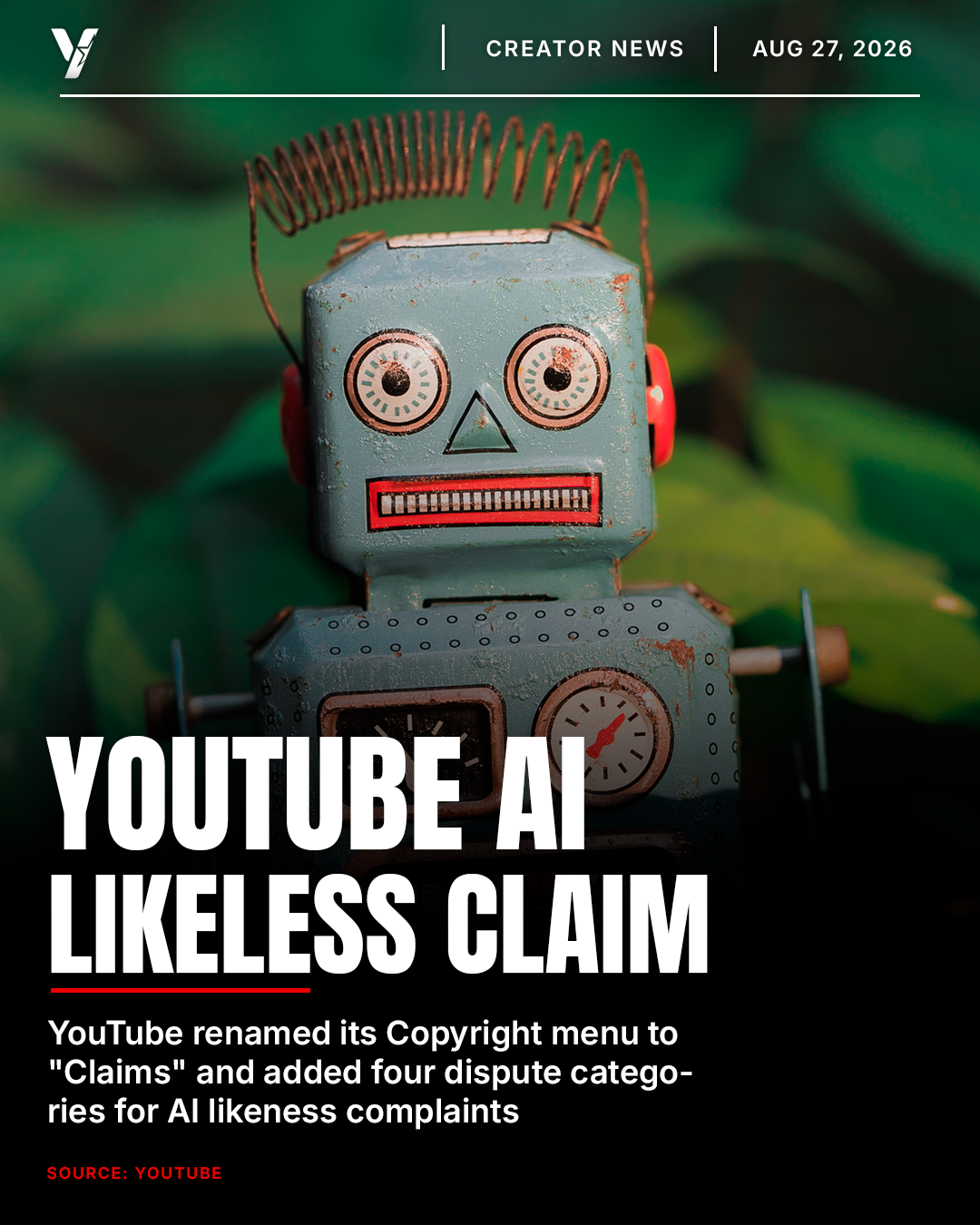
YouTube quietly rewired how creators see and fight two very different kinds of video restrictions. On August 19, the platform renamed the Copyright menu inside Video Details to a broader "Claims" tab, and it introduced four dispute categories creators can select when an AI likeness claim blocks one of their videos. The change does not touch any underlying policy, but it does give creators, for the first time, a formal, itemized way to push back when someone claims a video uses their face or voice without permission.
What Changed in YouTube Studio
The Claims tab now houses two distinct restriction types that used to live in separate parts of Studio: automated Content ID matches for music and video, and complaint-based likeness claims filed by a person (or someone acting on their behalf) who believes an AI-generated or altered video uses their face or voice without consent. YouTube described the move as "presentational rather than legal," meaning creators are not gaining or losing any rights. They are simply seeing both claim types in one place instead of hunting through separate menus.
The bigger addition is the dispute flow itself. Until now, a creator hit with a likeness claim had a narrow appeal path, if any real explanation at all. YouTube's help center, posted by a member of the TeamYouTube staff, laid out four specific categories a creator can now select to contest a claim:
- Explicit Consent: the creator shows documented, verified permission from the person to use their voice and/or visual likeness.
- Parody, Satire, or Public Interest: the video uses the AI depiction transformatively, for comedic effect, critique, or genuine newsworthy commentary.
- Content Not Altered or Made with AI: the footage is authentic and unedited, and no synthetic likeness was involved at all.
- Claimed Content Doesn't Appear: the video simply does not contain the person's actual face or voice as described in the claim.
Why This Matters More Than a Menu Rename
Likeness claims behave nothing like copyright claims, and that gap is exactly what made the old system frustrating for creators. A copyright claim on a piece of music, for example, usually still lets a video stay up and monetize, with revenue routed to the rights holder. A likeness claim carries no such option. There is no monetization split, no partial resolution: a video is either taken down or restricted from public view, and the only way back is a successful dispute. Neither claim type triggers a copyright strike or a Community Guidelines strike on its own, but a likeness claim can still cost a creator their video entirely while a dispute is pending.
This system exists on top of likeness detection, the tool YouTube built for people to upload a reference image or voice sample so the platform can automatically scan new uploads for their depiction. It started with YouTube Partner Program creators in 2024, expanded to journalists, government officials, and political candidates in March 2026, and opened to every eligible user 18 and older in May. That expansion is precisely why a clearer dispute process became necessary: more people filing likeness claims means more creators need a real way to contest one when it is filed in bad faith or by mistake.
Who Is Affected
Every channel that features real people on camera, uses AI avatars, voice clones, deepfake-style parody, or commentary built around a public figure's likeness is now operating inside this system. That covers a wide swath of YouTube: reaction channels, commentary and news channels, satire creators, AI content creators using synthetic hosts, and anyone whose videos include another person's face or voice, edited or not. A false or overzealous likeness claim can now be disputed with a named reason instead of a vague appeal, but it can also still take a video down first and ask questions later.
What Creators Should Do Now
- Get explicit, documented consent before featuring anyone's likeness in an AI-generated or altered format, and keep that paperwork somewhere retrievable.
- Check the new "Claims" tab in YouTube Studio's Video Details page instead of looking under "Copyright," since that's where likeness disputes now live alongside copyright claims.
- If a claim looks wrong, pick the dispute category that actually fits your case (consent, transformative use, no alteration, or mistaken identity) rather than a generic appeal.
- Build parody and commentary content with a clear transformative angle if it depicts real people, since "Parody, Satire, or Public Interest" is now a named category reviewers will evaluate against.
- Don't assume an AI disclosure label offers legal cover. It satisfies YouTube's transparency rules; it does not satisfy consent requirements tied to likeness claims.
“A likeness claim now comes with a name and a reason instead of a locked door. That is a real improvement, but it also means creators need to treat consent like a production requirement, not an afterthought.”
— YouTubeSkool Creator News Desk
What Comes Next
YouTube has not published a rollout timeline, geographic scope, or review benchmarks for the new dispute categories, and it has not said what share of disputes currently succeed. The Claims tab update is also the fourth restructuring of YouTube's restriction-reporting tools in the past twelve months, following a Content tab redesign in June, an Account Status page added to the mobile app in July, and expanded copyright claim emails for channel managers on August 14. That cadence suggests YouTube is still actively reshaping how creators interact with claims, and further changes to the dispute flow are likely before this settles into a permanent system.
For a platform racing to police an explosion of AI-generated and AI-altered video, a labeled, structured dispute process is overdue. It won't stop bad-faith claims from being filed, and it won't speed up how fast a wrongly blocked video comes back online. But it does turn what used to be a guessing game into something creators can actually prepare for, document, and argue with specifics instead of hoping a form letter works.
Frequently asked questions
What is YouTube's new "Claims" tab?+
It's a renamed and consolidated section inside YouTube Studio's Video Details page that combines Content ID copyright claims and AI likeness claims in one place. YouTube says the change is presentational, not a shift in underlying policy.
What are the four categories for disputing an AI likeness claim?+
Explicit Consent, Parody/Satire/Public Interest, Content Not Altered or Made with AI, and Claimed Content Doesn't Appear. Creators select whichever one matches their situation when they contest a claim.
Does a likeness claim hurt my channel like a strike would?+
No. YouTube says a valid likeness claim can restrict or block a specific video from public view, but it does not count as a copyright strike or a Community Guidelines strike, and it does not affect your channel's overall standing.
Does labeling my video as AI-generated protect me from a likeness claim?+
No. Disclosure and consent are separate requirements. A video can be properly labeled as synthetic under YouTube's AI disclosure rules and still get claimed and restricted if the person depicted never consented to the use of their likeness.
Who can file an AI likeness claim on YouTube?+
Any person 18 or older can opt into YouTube's likeness detection tool by verifying their identity and uploading a reference image, after which YouTube scans new uploads for their depiction. The tool has been available to all eligible users since May 2026, expanding from an earlier rollout limited to YouTube Partner Program creators, journalists, government officials, and political candidates.
Get the editing behind every winning video
Free 60-second channel audit, then get your content edited in your chosen style. Trusted by creators who treat YouTube like a business.
Related stories
 Monetization
YouTube's Monetization Rules Now Draw the Line on AI Slop
YouTube clarified its Partner Program guidelines on July 16, 2026, spelling out three categories of inauthentic content ineligible for monetization, from template-based videos to AI personas discussing health and finance.
 Growth
YouTube Renames Analytics to Insights, Adds AI Cards
YouTube is testing a Studio redesign that renames Analytics to Insights, adds AI insight cards, and turns Trends into a new Research tab.
 Industry
The FTC Is Reportedly Preparing a Complaint Over YouTube's Moderation Policies
Bloomberg reports the FTC is nearing a formal complaint against YouTube, alleging the platform told creators one set of content rules while enforcing a stricter, undisclosed standard behind the scenes.